Metaphor – “Kurt Browning is the Wayne Gretzky of Figure Skating”

In the listening lesson “Stars on Ice”, I used the metaphor “Kurt Browning is the Wayne Gretzky of figure skating.”
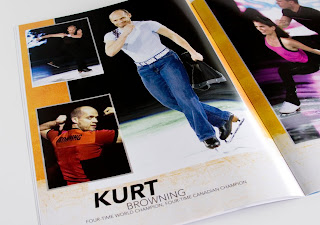
This is a very common way of comparing things in English. I describe Kurt Browning and his importance in the figure skating world by comparing him to someone with similar qualities.
The form of the metaphor is: _____ is the _____ of _____A is the B of C
A and C are related. A is being compared to B to show how important or how special A is in the field or area of C.
This way of comparing people or things relies on knowledge or information that people already have.
*
Who is Wayne Gretzky? In Canada, Gretzky is extremely popular. He is the greatest hockey player in history. He is loved and respected across Canada, not only because he is a great hockey player but also because he is a good person. In addition to playing and coaching hockey, he also does a lot of charity work.
Wayne Gretzky is not a figure skater, Kurt Browning is. Gretzky has been around longer than Browning, so I used him as the point of reference. Kurt Browning is also the best in his sport. He has achieved great things and done a lot to promote figure skating in Canada. He is popular and well-loved. He also does a lot of good work outside of figure skating. By comparing him to Gretzky, people can understand his importance to figure skating.
*
Let’s look at some other examples:
Amsterdam is the Venice of northern Europe.
Venice is a city in Italy that is well-known for its canals. Most people don’t know that Amsterdam is also made up of canals. Amsterdam is a city in the Netherlands in northern Europe. This comparison tells people that Amsterdam is actually quite similar to Venice.
The Twilight Saga is the Harry Potter of the 2000s.
J.K. Rowling introduced Harry Potter to the world in 1997. The books became wildly popular in the late 1990s and encouraged many young people to start reading. The Twilight Saga was first introduced to the world in 2005. The Twilight books appealed to a smaller audience than the Harry Potter books, but they still became wildly popular and also encouraged young people to read.
*
Have you ever seen or heard of this kind of metaphor before? Can you think of another example?